> For the complete documentation index, see [llms.txt](https://chaoslabz.gitbook.io/tracepulse/llms.txt). Markdown versions of documentation pages are available by appending `.md` to page URLs; this page is available as [Markdown](https://chaoslabz.gitbook.io/tracepulse/readme.md).
# What is TracePulse?
**TracePulse - Runtime feedback MCP server.**
*Fewer wasted tokens. Faster shipping. Lower carbon footprint. Responsible AI in action.*
\[[ViewGraph](https://chaoslabz.gitbook.io/viewgraph) sees the UI. TracePulse hears the backend.
> "LLMs can't see what happens when their code actually runs. They're throwing darts in the dark."
>
> * [Sentry Engineering](https://blog.sentry.io/vibe-coding-closing-the-feedback-loop-with-traceability/)
TracePulse closes this loop at dev time - seconds after the code change, not minutes after deployment.
[](https://www.npmjs.com/package/tracepulse) [](https://github.com/sourjya/tracepulse)
***
## The Problem
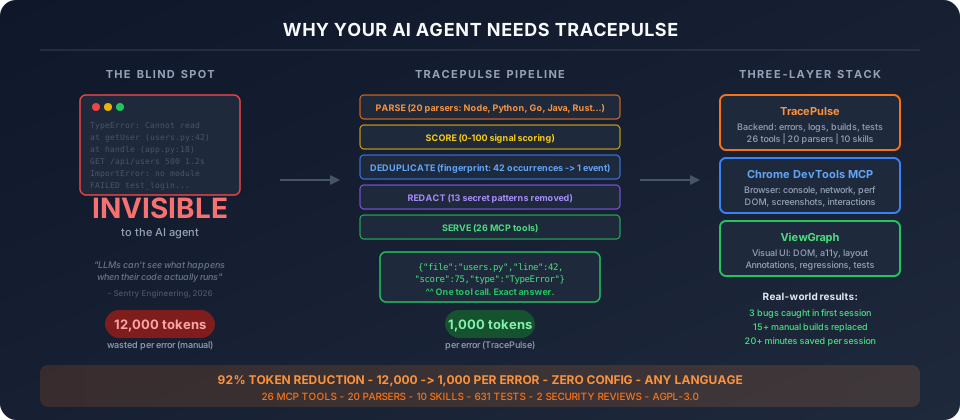
**AI coding agents can write code. They cannot see what happens when it runs.**
* The agent edits a file but **can't tell if the server crashed**
* Errors pile up in terminal logs that the agent **never reads**
* Build failures are invisible until the developer **manually checks**
* The agent iterates blindly, **compounding errors** on top of errors
* Debugging requires **copy-pasting logs** into the chat
These problems cost 15-30 minutes per debugging session. TracePulse eliminates them.
***
## Why It Matters Beyond Productivity
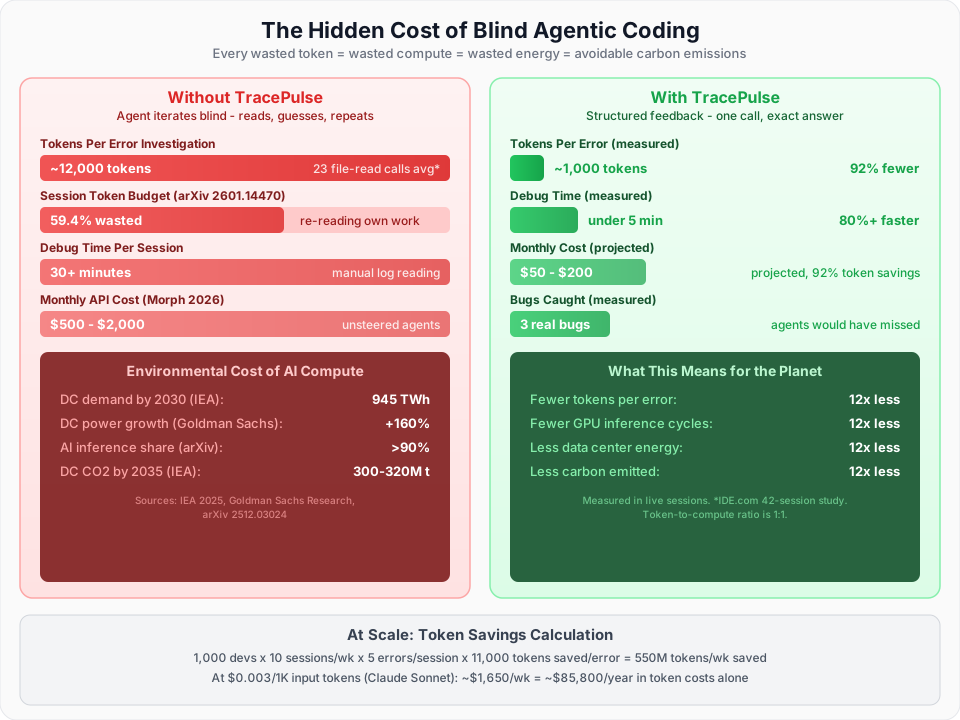
Every wasted token is wasted compute, wasted energy, and avoidable carbon emissions.
* [59.4% of token consumption](https://arxiv.org/html/2601.14470v1) in agentic coding goes to the agent re-reading its own work (arXiv 2601.14470)
* Global data center electricity demand projected to [double to \~945 TWh by 2030](https://www.iea.org/news/ai-is-set-to-drive-surging-electricity-demand-from-data-centres-while-offering-the-potential-to-transform-how-the-energy-sector-works) - more than Japan's entire consumption (IEA, 2025)
* [LLM inference accounts for >90%](https://arxiv.org/html/2512.03024) of total AI power consumption - not training (arXiv 2512.03024)
* Data center CO2 emissions projected to rise from [\~220M to 320M tonnes by 2035](https://www.iea.org/reports/energy-and-ai/ai-and-climate-change) (IEA)
**The chain:** Wasted tokens -> wasted GPU cycles -> wasted data center energy -> avoidable carbon emissions. TracePulse breaks this chain at the source.
***
## Your Agent Is Wasting Tokens
Research from [Morph](https://www.morphllm.com) (2026), [Cognition](https://cognition.ai) internal measurements, and [SWE-Pruner](https://arxiv.org/abs/2601.16746) (arXiv 2601.16746) shows AI agents spend **60-80% of their token budget** on orientation and retrieval, not problem-solving. One developer [tracked every token](https://ide.com/i-tracked-every-token-my-ai-coding-agent-consumed-for-a-week-70-was-waste/) across 42 Claude Code sessions on a real codebase and found **70% waste** - an average of 23 file-read tool calls per prompt, with only 50K of 180K tokens actually relevant to the question.
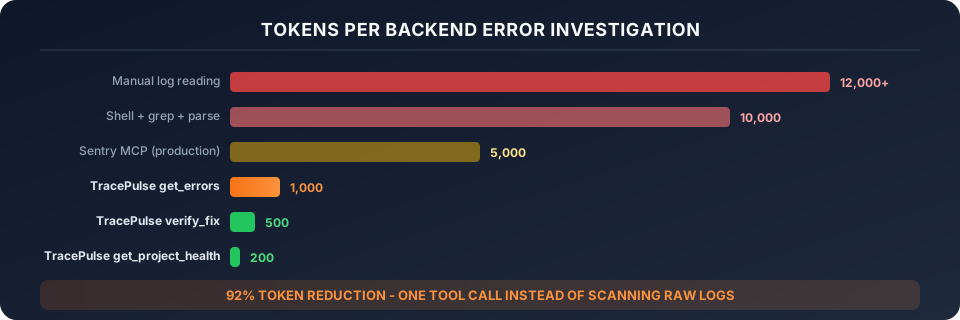
TracePulse pre-parses, scores, and deduplicates. The agent gets the exact file:line in one call instead of scanning raw logs.
**That's 12,000 tokens down to 1,000. Per error. Per session.** (Measured in live debugging sessions - see [TracePulse in Action](/tracepulse/tutorials/tracepulse-in-action.md))
***
## What Makes It Different
| Capability | TracePulse | Sentry MCP | Chrome DevTools | BrowserTools |
| ------------------------ | :----------: | :----------: | :-------------: | :----------: |
| Backend error parsing | **Yes (26)** | Yes (prod) | No | No |
| Signal scoring (0-100) | **Yes** | No | No | No |
| Fingerprint dedup | **Yes** | No | No | No |
| Hot-reload detection | **Yes (12)** | No | No | No |
| Dev-time (seconds) | **Yes** | No (minutes) | Yes | Yes |
| Works without browser | **Yes** | Yes | No | No |
| Test runner integration | **Yes** | No | No | No |
| Infrastructure discovery | **Yes** | No | No | No |
| Agent skill files | **Yes (10)** | No | No | No |
| Zero config | **Yes** | No | Yes | No |
[Full feature matrix ->](/tracepulse/how-it-compares/feature-matrix.md)
***
## Real-World Results
From live agent sessions across 4 projects (full-stack web app, TypeScript library, Python backend, shared libraries):
| Metric | Value |
| ---------------------------- | -------------------------- |
| Token reduction per error | 12x (measured) |
| Chokepoints caught by TP | 7/8 (88%) |
| Avg attempts before fix | 1.5 (structured file:line) |
| Tool calls per session | 40-70 |
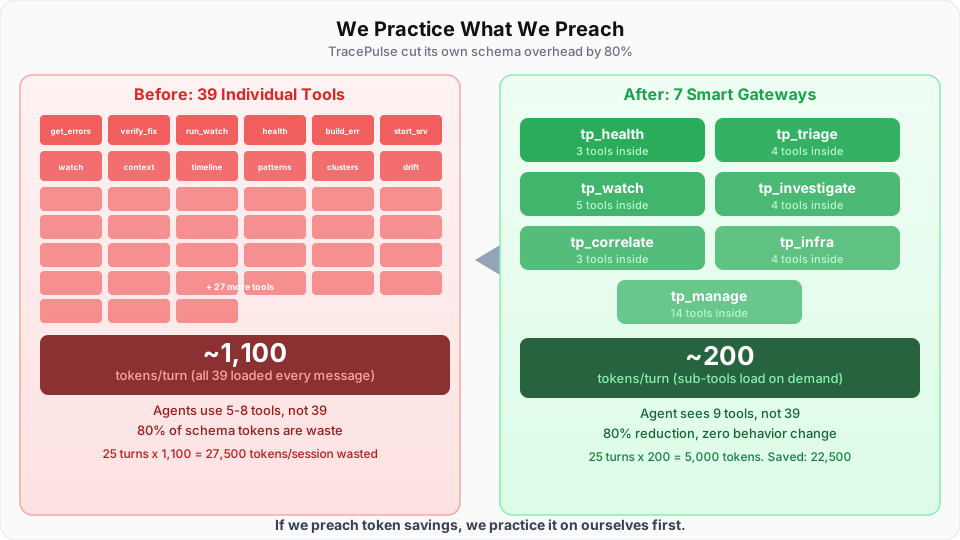
| Schema overhead reduction | 80% (clustered mode) |
| Agent wishlist items shipped | 24/38 (63%) |
| Real bugs caught per session | 3 |
***
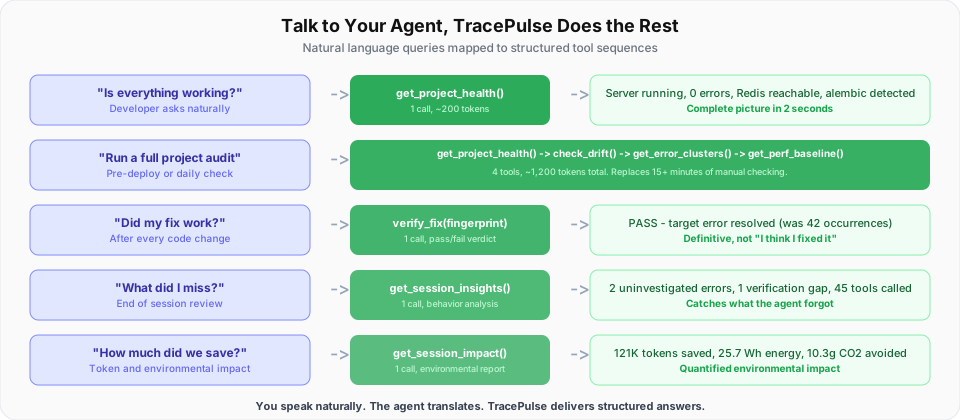
## Just Ask
You don't need to remember tool names. Ask your agent naturally and TracePulse translates:
[See all query mappings ->](/tracepulse/tutorials/project-audit.md)
***
## Install
```json
{
"mcpServers": {
"tracepulse": {
"command": "npx",
"args": ["tracepulse", "start", "npm run dev"]
}
}
}
```
Works with [Kiro](/tracepulse/getting-started/mcp-client-setup.md), [Cursor](/tracepulse/getting-started/mcp-client-setup.md), [Claude Desktop](/tracepulse/getting-started/mcp-client-setup.md), [VS Code](/tracepulse/getting-started/mcp-client-setup.md), [Windsurf](/tracepulse/getting-started/mcp-client-setup.md), and any MCP-compatible agent.
***
## Cloud Log Monitoring
Monitor 9 cloud platforms with zero additional dependencies:
| Platform | Command |
| -------------------------------------------------------------------------------------------------------------------------------------------------- | ----------------------------------------------------------- |
| [**AWS CloudWatch**](https://docs.aws.amazon.com/cli/latest/userguide/getting-started-install.html) | `run_and_watch("aws logs tail /aws/lambda/my-fn --follow")` |
| [**Google Cloud**](https://cloud.google.com/sdk/docs/install) | `run_and_watch("gcloud logging tail '...'")` |
| [**Azure**](https://learn.microsoft.com/en-us/cli/azure/install-azure-cli) | `run_and_watch("az webapp log tail --name my-app")` |
| [**Kubernetes**](https://kubernetes.io/docs/tasks/tools/) | `run_and_watch("kubectl logs -f deployment/my-app")` |
| [**Docker**](https://docs.docker.com/get-started/get-docker/) | `run_and_watch("docker logs -f my-container")` |
| [**Heroku**](https://devcenter.heroku.com/articles/heroku-cli) | `run_and_watch("heroku logs --tail --app my-app")` |
| [**Vercel**](https://vercel.com/docs/cli) / [**Railway**](https://docs.railway.com/guides/cli) / [**Fly.io**](https://fly.io/docs/flyctl/install/) | Same pattern with their CLIs |
The same 25 parsers that catch local dev server errors catch cloud errors too.
[Full cloud monitoring guide ->](/tracepulse/tutorials/cloud-logs.md)
***
## Open Source
AGPL-3.0 licensed. Full source on [GitHub](https://github.com/sourjya/tracepulse).
| Resource | Link |
| -------- | -------------------------------------------------------------------------- |
| npm | [npmjs.com/package/tracepulse](https://www.npmjs.com/package/tracepulse) |
| GitHub | [github.com/sourjya/tracepulse](https://github.com/sourjya/tracepulse) |
| Docs | [chaoslabz.gitbook.io/tracepulse](https://chaoslabz.gitbook.io/tracepulse) |
***
## Quick Links
* [Quick Start (2 minutes) ->](/tracepulse/getting-started/quick-start.md)
* [44 MCP Tools ->](/tracepulse/features/mcp-tools.md)
* [25 Error Parsers ->](/tracepulse/features/parsers.md)
* [How It Works ->](/tracepulse/architecture/how-it-works.md)
* [Feature Matrix vs Competitors ->](/tracepulse/how-it-compares/feature-matrix.md)
* [The Three-Layer Stack ->](/tracepulse/architecture/three-layer-stack.md)
---
# Agent Instructions
This documentation is published with GitBook. GitBook is the documentation platform designed so that both humans and AI agents can read, navigate, and reason over technical content effectively. Learn more at gitbook.com.
## Querying This Documentation
If you need additional information that is not directly available in this page, you can query the documentation dynamically by asking a question.
Perform an HTTP GET request on the current page URL with the `ask` query parameter, and the optional `goal` query parameter:
```
GET https://chaoslabz.gitbook.io/tracepulse/readme.md?ask=&goal=
```
`ask` is the immediate question: it should be specific, self-contained, and written in natural language.
`goal` is optional and describes the broader end goal you are ultimately trying to accomplish on behalf of the user. GitBook uses it to tailor the answer towards what is most useful for that goal.
The response will contain a direct answer to the question and relevant excerpts and sources from the documentation.
Use this mechanism when the answer is not explicitly present in the current page, you need clarification or additional context, or you want to retrieve related documentation sections.